Dofus Retro multi-account play is one of the most powerful levers in the game: it turns a lone character into a real team that can farm, craft, sell on the HDV and clear dungeons in parallel. Whether you want to carry more resources, beat fights as a team or simply multiply your kamas income, running several accounts radically changes how you play.
The catch is that manually piloting five, ten or fifty characters quickly becomes a nightmare: chained logins, configs to copy over and over, movements to sync one by one. This is exactly where MoonBot comes in. This complete guide covers everything: why play multi-account, the difference between mules and teams, leader + mule coordination, the account creator, and how to scale from 5 to 400 accounts, 100% in the cloud.
Why play multi-account
On Dofus Retro, running several accounts answers three big needs. The first is logistical: a single character is quickly limited by its pods. One or more mules dedicated to carrying loot multiply your gathering capacity and save you endless round trips to the bank.
The second need is tactical. In combat, a full team covers every role: an Eniripsa to heal, a Sram to burst, a Sacrier to tank, a Cra to deal ranged damage. Instead of waiting for a player group, you build your own team and tackle dungeons at your own pace. It is also a huge accelerator for combat XP, since every character gains experience on each win.
The third need is economic: multi-account play is a kamas multiplier. More characters means more leveled professions, more gathering nodes worked and more lots sold on the HDV. If your main goal is to farm kamas automatically, every extra account adds an independent income stream.
Important: automating several accounts with a bot breaks Ankama's terms of service and carries a risk of sanction. No tool can remove that risk. MoonBot is independent third-party software, not affiliated with Ankama.
Mules, teams and bot mules
Before configuring anything, you need to separate two very different uses of multi-account play.
The mule
A mule is a secondary account whose role is passive or utilitarian. It does not necessarily fight: it carries pods, deposits resources at the bank, feeds the crafting workshop or holds a selling stall on the HDV. A well-tuned bot mule runs in the background while your main character gathers or grinds XP. This is the most common and most profitable use to start with.
The team
The team, on the other hand, is a group of active characters that fight together. Each member has a precise combat role and synchronizing actions becomes crucial: coordinated movement, strategic placement before the turn, casting spells in the right order. A team is more demanding to configure than a simple mule, but far more powerful for dungeon farming and XP.
| Criterion | Mule | Team |
|---|---|---|
| Role | Carrying, crafting, HDV, support | Full active combat |
| Complexity | Low | High (synchronization) |
| Main goal | Logistics and kamas | Dungeons and XP |
| Coordination needed | Light | Strong (leader + mules) |
In practice, most players combine both: a combat team backed by one or two mules to empty inventories and handle selling. MoonBot manages both setups within the same interface.
Leader + mule coordination
The heart of multi-account play in MoonBot is the coordinated groups system. You designate one account as the leader and the others become its mules. The leader makes the movement and combat decisions, and the mules follow or mirror its actions depending on your configuration.
Concretely, this leader + mule architecture lets you automate:
- Synchronized movement of the group from map to map without desyncing.
- Team combat, where mules engage and cast their spells in coordination with the leader.
- Coordinated actions such as item exchange between members or grouped dungeon entry.
- Collective bank emptying, ideal for pooling the whole team's resources.
The big advantage is that you only pilot one brain: the leader. You do not have to micro-manage each mule individually. The system relays orders to the entire group, which is what makes multi-account play genuinely sustainable beyond two or three characters.

The 3 synchronized movement modes
Moving a whole group without a member getting lost on the way is one of the classic multi-account challenges. MoonBot offers three synchronized movement modes to fit every situation, which can be illustrated as follows:
- Follow the leader: mules step in behind the leader, map after map. This is the simplest mode, ideal for bringing the whole team to a farming zone or to a dungeon entrance.
- Move to a common target: each character heads to a defined point, each taking its own optimized route. Useful when accounts start from different positions.
- Coordinated independent movement: each member follows its own path but the group stays synced on key steps, for example so everyone reaches the fight at the same time.
These modes rely on MoonBot's World Pathfinding, which automatically handles map-to-map navigation, zaaps, zaapis, doors and even ghost and phoenix modes after a lost fight. You set a destination, and the group travels there on its own.
For group resource farming, combine the follow-the-leader mode with smart anti-aggro: mules dodge monsters while moving, which avoids stray fights that desync the team.
Mass connection and configuration
Managing ten accounts is doable by hand. Managing fifty is impossible without mass tools. MoonBot was designed for this from the start.
From a single interface, you can:
- Mass connect or disconnect your entire account fleet in one click, rather than one by one.
- Launch scripts on all selected accounts simultaneously.
- Monitor in real time the state of each bot: position on the world map, live logs, detailed statistics.
But the most valuable tool at scale is the configurator. Instead of setting up each account individually, you tune one reference configuration (combat, gathering, HDV, craft) and push it to all your accounts in a single click. If you decide to change your HDV selling strategy, for instance adjusting the priority-item list or the floor price, you apply it to the whole fleet instantly.
All of this runs on MoonBot's full Lua scripting, which exposes 395 functions across 20 namespaces. If you want to go beyond visual configurations, you can write your own group-coordination scripts and broadcast them to every account. The full documentation is available at doc.moon-bot.io.
Creating accounts in bulk
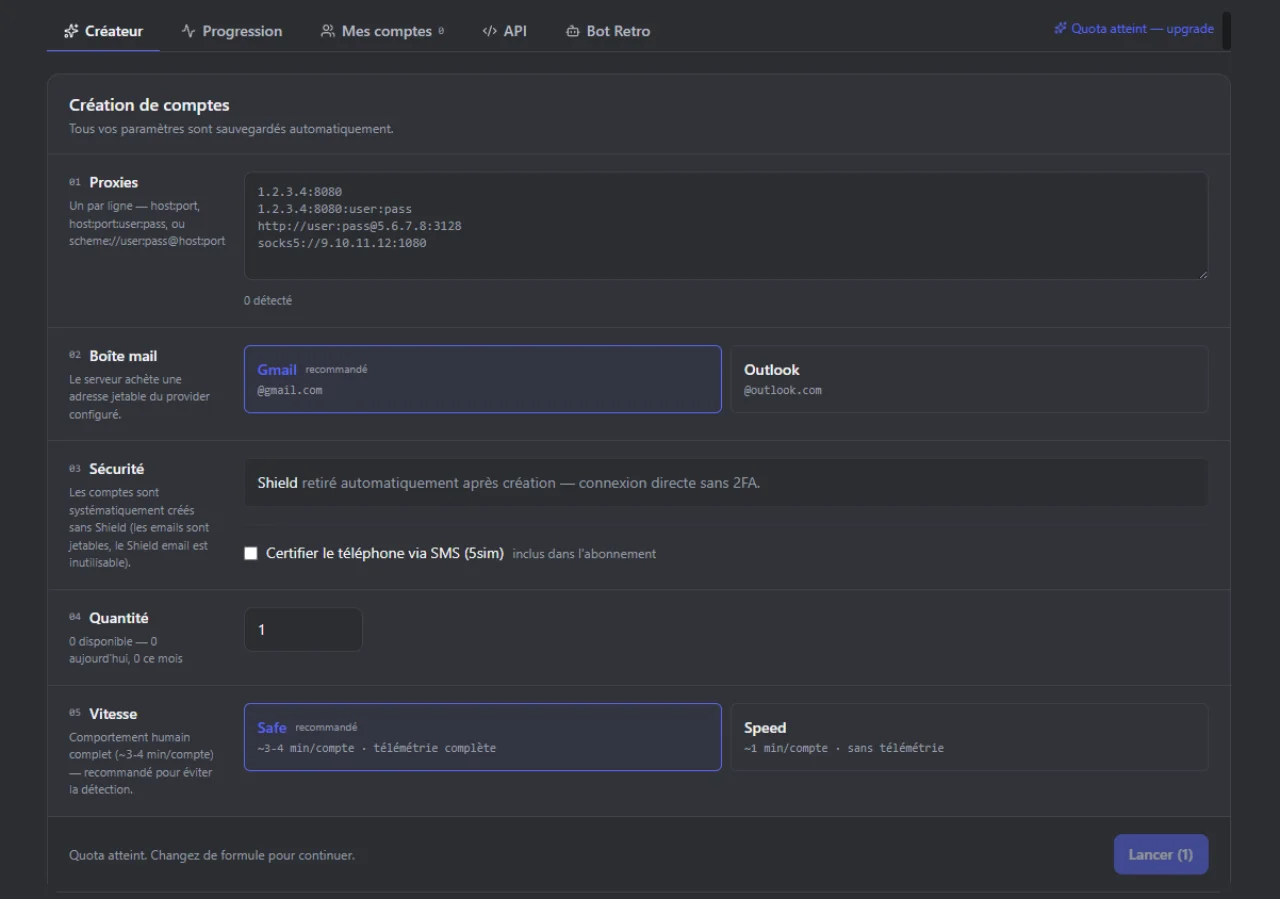
Before coordinating a team, you first need the accounts. Manually creating twenty Dofus Retro accounts, with emails, verifications and shield removal, takes hours. MoonBot also offers an account creator, a separate service with its own account and subscription, to automate this step: account-creator.moon-bot.io.
The tool automatically handles:
- Buying disposable emails for each account, so you do not have to provide them yourself.
- Multi-format proxies, so you do not create all your accounts from the same address.
- Automatic shield removal.
- SMS verification via 5sim, to clear the phone validation step.
In Safe mode, creation takes about 3 to 4 minutes per account, a deliberately measured pace to stay credible. This is how you build your fleet of mules and team characters without spending your evenings on it.
Scaling from 5 to 400 accounts in the cloud
Here is the point that changes everything compared to classic bots: MoonBot is 100% cloud. There is nothing to install, no VPS to rent and no PC to leave running all night. Your accounts run on MoonBot's servers and you pilot them from a simple browser, even from your phone.
This makes scaling painless. Where running fifty Dofus Retro clients locally would choke any machine, MoonBot absorbs the load server-side. To understand in detail why this approach is superior, read our dedicated guide to the cloud Dofus Retro bot with no VPS.
Sizing follows your needs, and the plans are built for multi-account play:
| Plan | Bots | Price /month | Cost per bot |
|---|---|---|---|
| Free | up to 5 (1 bot for every 5 validated Discord invites) | €0 | — |
| Beginner | 10 | €29 | ~€2.90 |
| Standard (popular) | 50 | €87 | ~€1.74 |
| Pro (best value) | 200 | €187 | ~€0.94 |
| Expert | 400 | €340 | ~€0.85 (then +€0.70 per extra bot) |
You can see right away that the higher the tier, the lower the cost per bot. A beginner team fits comfortably in the free tier, while an industrial farming project of several hundred accounts becomes economically viable with Pro or Expert. Full details on the pricing page.
Scheduling at scale
The more accounts you run, the more organization matters. MoonBot gathers the useful settings in the account manager.
You can define per-day connection time ranges for each account, so your characters do not run 24/7, and push the same configuration to the whole team in one click.
Pauses and automatic reconnection keep an account from staying stuck after a disconnection. At scale, also spread your accounts across several farming zones so you do not compete with yourself for resources.
No feature guarantees you will not get banned. Botting remains against the game's terms of service: play in moderation, and do not invest more into an account than you are willing to lose.
Ready-to-run scripts. Don't feel like setting everything up yourself? The community publishes its multi-account scripts for Dofus Retro on the MoonBot marketplace, free or paid: browse the Dofus Retro multi-account scripts. Each page describes what the script does; you then get it from the Marketplace tab of the app.
Conclusion: launch your team
Dofus Retro multi-account play multiplies everything: gathering, kamas, XP and dungeon power. With leader + mule coordination, the three synchronized movement modes, mass connection and configuration, the account creator and 100% cloud operation, MoonBot turns a normally unmanageable task into a smooth system, from 5 to 400 accounts.
The best way to judge for yourself is to try it. The Free tier lets you pilot up to 5 bots (1 bot for every 5 validated Discord invites) without spending a single kama. Create your account on the MoonBot dashboard, compare the plans on the pricing page, and if you are still weighing the options on the market, read our comparison of the best Dofus Retro bots in 2026. Got a question? Join the community on Discord.
