Picking a bot for Dofus Retro 1.48 is rarely obvious: between long-standing tools, community projects and newer solutions, it is easy to get lost. The MoonBot vs AnkaBot vs DofusBot question keeps coming up on Discord servers and forums, and for good reason: these three names represent three different philosophies of automation. In this guide we lay things out honestly to help you decide which Dofus Retro bot to choose based on your player profile.
Before diving in, let's be clear: automation goes against the game's terms of service and always carries a risk of sanction. No bot, whatever it is, can promise zero ban. So we will talk about risk reduction, never a guarantee. And because AnkaBot and DofusBot are third-party tools whose features and prices change over time, we will stay cautious and factual about them, focusing on what MoonBot brings that is verifiable.
The three bots at a glance
The Dofus Retro bot market has organized itself around a handful of major players. AnkaBot and DofusBot are among the names most cited by the community, often associated with the classic approach: software you install and run on your own machine. It is a proven model, but it means managing the infrastructure, updates and uptime yourself.
MoonBot takes a radically different route. It is a 100% cloud bot for Dofus Retro 1.48 (with a Dofus Touch variant too): nothing to install, no VPS to rent and no PC to leave running. Everything is controlled from a web browser, even from a phone. This architectural difference shapes almost everything else in the comparison, as we'll see.
Beyond hosting, all three tools cover the broad feature families expected from a modern bot: automatic combat, gathering, marketplace (HDV) selling, crafting and multi-account management. The nuance lies in depth, ergonomics and how those features are exposed to the player. If you want a wider view of the segment, our best Dofus Retro bots 2026 comparison goes beyond just these three names.
Cloud vs local install
This is the most structural point of divergence. Most bots of this type have historically run locally: you install a client on your PC, launch it, and it has to stay open for the bot to run. To bot around the clock, many players then rent a VPS, adding real cost and technical complexity.
MoonBot removes that constraint. Because everything runs in the cloud, you close your browser and your bots keep playing. You can watch your characters from your phone on the train, tweak a config at lunch from work, then shut it all down in the evening: the session does not depend on your hardware. We break this down in our dedicated article on a cloud Dofus Retro bot with no VPS.
In practice: no VPS to configure, no updates to install manually, no risk that your PC crashes and stops the session. The infrastructure is managed for you, which is a game changer once you run several accounts.
The local approach still has its supporters: some players prefer to host everything themselves for control or privacy reasons. That is a legitimate choice. But for the majority who simply want things to run without dedicated hardware, MoonBot's cloud model takes a big thorn out of the equation.
There is also a reliability angle. A local setup is only as stable as your home connection, your power supply and your operating system. A power cut, a Windows update reboot or a flaky router can quietly kill a farming session you thought was running all night. With a cloud bot, those single points of failure move off your desk, which is one less thing to babysit when you are farming kamas or grinding XP across several characters.
Multi-account and coordination
On Dofus Retro, the appeal of botting really takes off once you go multi-account. Managing several characters is therefore a major comparison criterion. Most bots let you launch multiple instances, but the experience varies enormously by tool, especially once you go past a handful of accounts.
MoonBot was designed for scale. From a single interface you manage dozens of accounts: mass connect and disconnect, script launching, real-time monitoring. A configurator even lets you push a single configuration to every account in one click, so you do not have to set up each character individually. Our Dofus Retro multi-account guide details these workflows.
Beyond raw management, MoonBot offers coordinated groups: a leader and its mules, with synchronized movement (three movement modes), team combat, coordinated actions and automatic bank emptying. This level of group coordination is exactly what separates running ten isolated accounts from orchestrating a real farming team.
- Mass connect: the whole group online or offline at once.
- Global configurator: one config pushed to every account.
- Synchronized movement: leader and mules move together.
- Team combat and coordinated actions across characters.
Scripting and customization
For advanced players, the ability to program your own behaviors is decisive. This is where MoonBot shows a very concrete, verifiable edge: a Lua API with 395 functions across 20 namespaces (combat, map, inventory, HDV, craft, professions/jobs, group, npc, quest, mount, exchange, chat, bot, character, controller, config, merchant, fm, global, structure), backed by public documentation available to everyone.
Most bots of this type offer some degree of customization, but the level of openness, API stability and documentation quality vary widely from one tool to the next. Having public docs and a browser-integrated script editor lowers the barrier to entry dramatically: you can write, test and fix a script without leaving the interface.
-- Minimal example: gather, then sell and deposit once the bag is full
function move()
  config.setBankThreshold(90)          -- bank() once pods reach 90%
  return { { map = "5,-24", path = "right", gather = true } }
end

function bank()
  return {
    { map = "5,-17", sale = true },     -- marketplace
    { map = "4,-17", npcBank = true },  -- bank
  }
end
The breadth of namespaces matters in practice. Because the API touches combat, gathering, HDV, crafting, professions and group coordination, you can chain behaviors that a more rigid bot would force you to run as separate, disconnected tasks. For instance, a single script can farm a resource, walk back to the bank, deposit, then list overflow items on the HDV at the right lot size, all without manual intervention.
You do not need to be a developer to benefit: many players start from existing scripts and tweak them. To learn step by step, follow our Lua scripting tutorial for Dofus Retro, which starts from the basics and ramps up gradually.
Risks and responsibility
No serious bot should promise immunity. Botting remains against the game's terms of service and exposes accounts to sanctions, whatever the tool.
MoonBot is no exception. On the settings side, it offers per-day connection time ranges, pauses and automatic reconnection, which you adjust account by account.
Let's be honest: no feature removes the risk of a ban. Limit your sessions, avoid farming 24/7 on a main account, and treat any sanction as a real possibility.
Comparison table
Here is a summary of the key criteria. For AnkaBot and DofusBot we deliberately use hedged labels (varies, depends on version) rather than claims we cannot verify, because their features evolve.
| Criterion | MoonBot | AnkaBot | DofusBot |
|---|---|---|---|
| Fully cloud hosting | Yes | Varies / typically local | Varies / typically local |
| No VPS or running PC | Yes | — | — |
| Browser + phone control | Yes | Varies | Varies |
| Multi-account at scale | Dozens, single interface | Varies | Varies |
| Coordinated groups (leader + mules) | Yes, 3 modes | Varies | Varies |
| Public Lua API | 395 functions, 20 namespaces | Varies | Varies |
| Public documentation | Yes (doc.moon-bot.io) | Varies | Varies |
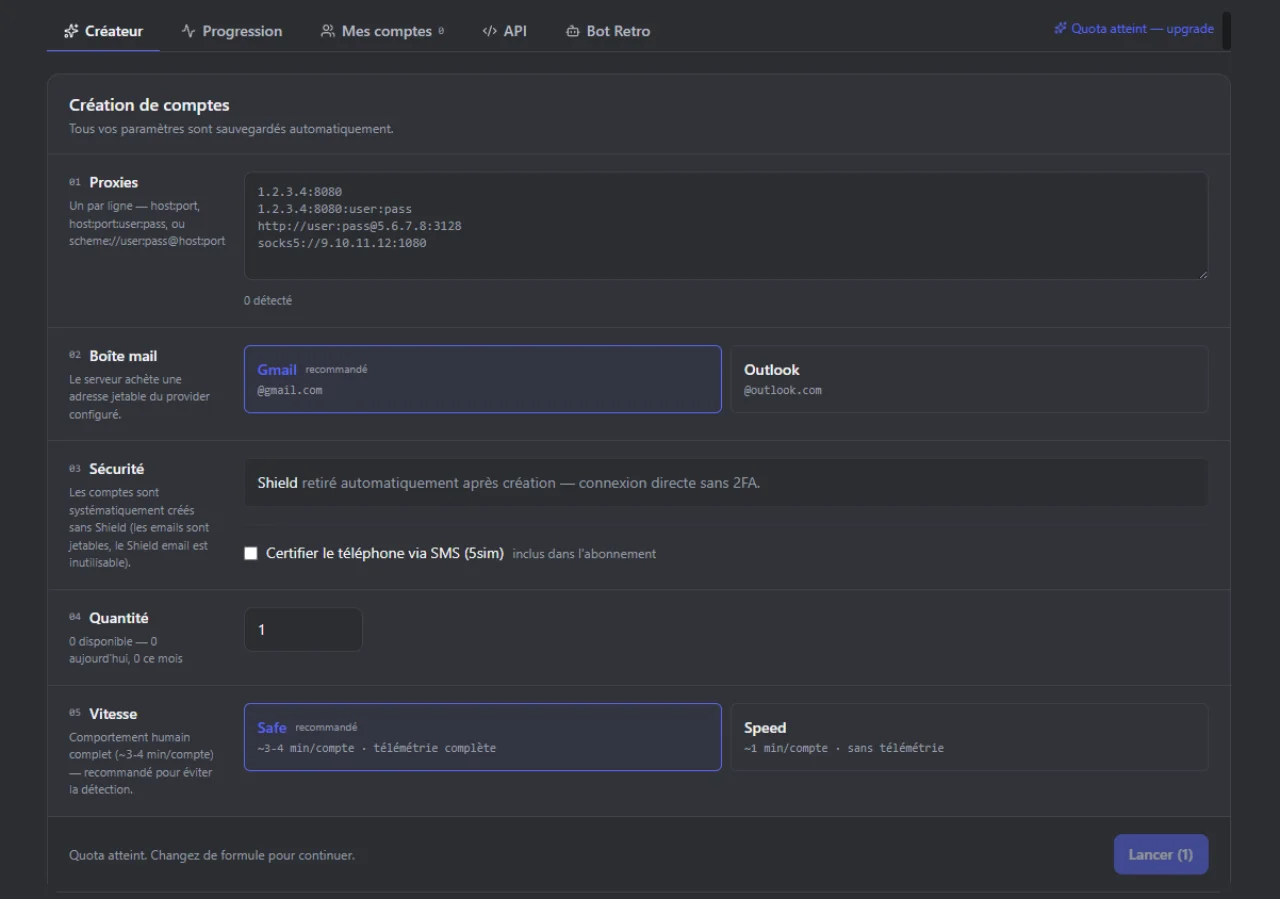
| Account creator (separate service, separate subscription) | Yes | — | — |
| Connection scheduling | Time ranges, pauses, reconnection | Varies | Varies |
| Free tier | Up to 5 bots | Varies | Varies |
This table is not meant to disparage the other tools: it highlights what MoonBot brings that is measurable. A dash simply means the feature is not a known, verifiable strength of the tool in question, not that it is necessarily absent.
Pricing and value
Since AnkaBot and DofusBot prices vary and change, we will not quote figures for them. MoonBot's pricing, on the other hand, is public and readable. It is designed so the cost per bot drops sharply as your volume grows, which is attractive for multi-account play.
- Free: up to 5 bots (1 bot for every 5 validated Discord invites). Ideal for testing.
- Beginner: 29 EUR/month, 10 bots.
- Standard: 87 EUR/month, 50 bots (about 1.74/bot) — the popular plan.
- Pro: 187 EUR/month, 200 bots (about 0.94/bot) — best value.
- Expert: 340 EUR/month, 400 bots, +0.70 per extra bot.
The appeal of the cloud model is clear here: with a local bot, running 50 accounts around the clock would often imply VPS costs and maintenance time that MoonBot's pricing already absorbs. Check the full pricing page to compare against your own situation.
Which bot for which player?
Rather than crown a single winner, here is how to reason based on your profile.
The player who wants to self-host everything
If total control of the infrastructure matters more than convenience, a classic local bot like those in the AnkaBot or DofusBot segment can suit you. You accept managing the machine, updates and uptime.
The player who wants it to just run
If you want no VPS, no running PC and no install, MoonBot is built precisely for that case. You control everything from a browser or phone, and the session does not stop when you close the tab.
The intensive multi-account player
To orchestrate dozens of accounts with coordinated leader-plus-mules groups, MoonBot's single interface and global configurator save a huge amount of time. This is where the gap widens the most.
The tinkerer and scripter
If you enjoy programming your own routines, the 395-function Lua API and its public docs offer a rare degree of customization. You build exactly the behavior you want.
Conclusion: our verdict
At the end of this MoonBot vs AnkaBot vs DofusBot comparison, there is no universal answer, but a clear logic. If you favor local hosting and full control of your machine, the long-standing tools keep their audience. If you want a 100% cloud Dofus Retro bot, controllable from a browser and phone, built for multi-account and richly scriptable, MoonBot ticks boxes that few alternatives combine in a verifiable way.
The best move is to try it yourself. The free tier of up to 5 bots lets you test without commitment: create your access on the MoonBot dashboard, explore the API through the documentation, and compare plans on the pricing page. Got a question? The community answers on Discord. Keep in mind that botting carries risk: play carefully.